

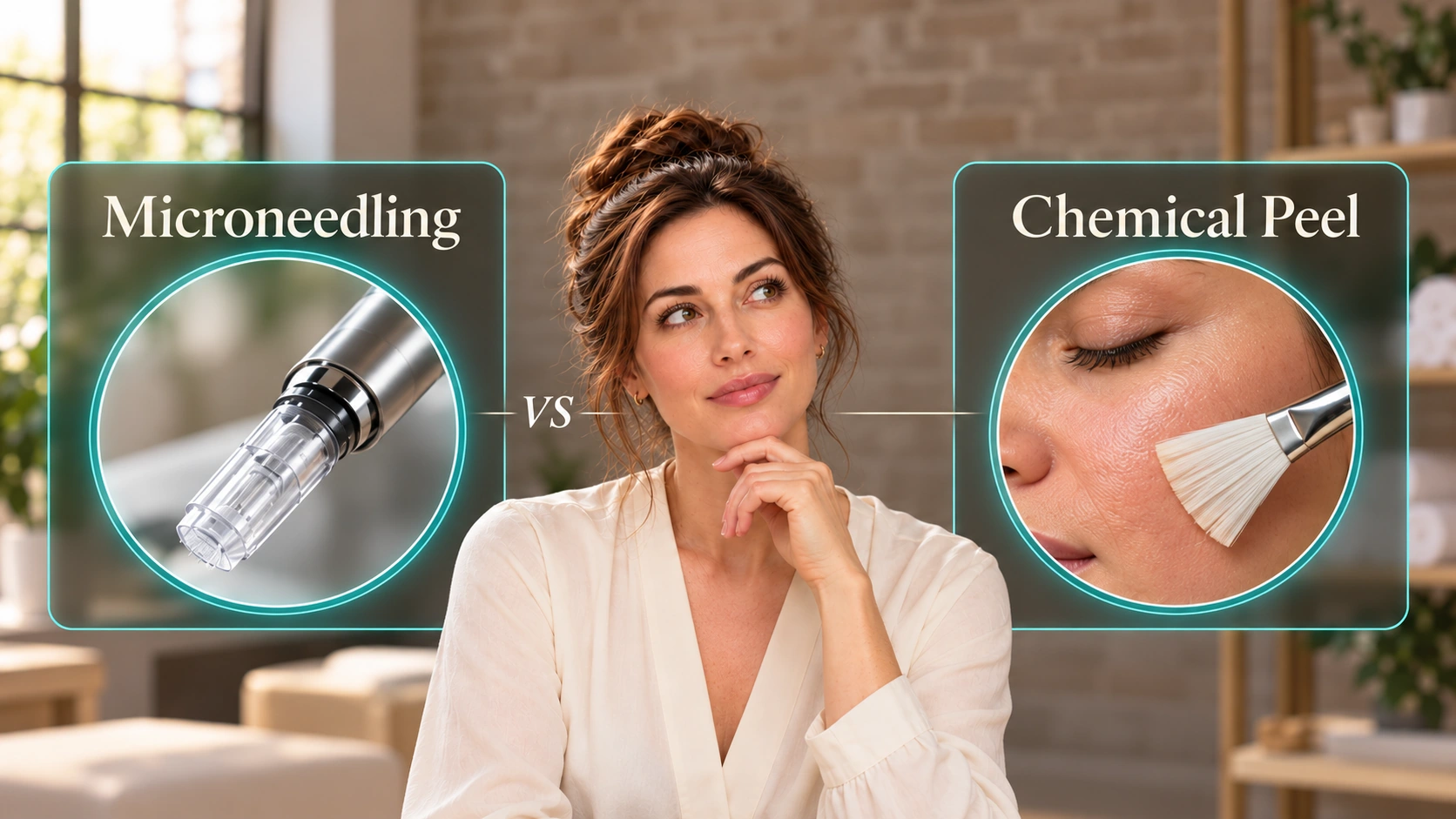

Microneedling vs chemical peel: which is better for your skin? The answer depends on what you want to improve. Microneedling is generally better suited for acne scars, uneven texture, fine lines, and concerns related to collagen loss. Chemical peels are often a better choice for dullness, superficial discoloration, clogged pores, and rough skin that needs resurfacing. Both treatments can improve the appearance of your skin without surgery, but they work differently, involve different recovery experiences, and carry their own risks.
Choosing between them isn’t simply about which treatment delivers more dramatic results. It’s about finding the right approach for your skin concerns, sensitivity, lifestyle, and tolerance for downtime. Here’s what makes each treatment different, where they overlap, and how to decide which deserves a spot in your skincare routine.
Microneedling vs Chemical Peel: What’s the Difference?
Both treatments aim to improve skin quality, but they take very different routes to get there.
Microneedling: Encouraging Skin Renewal From Within
Microneedling uses tiny, controlled needle punctures to create micro-injuries in the skin. These trigger the body’s natural repair response, encouraging collagen and elastin production over time.
Because collagen provides structure and firmness, microneedling can be particularly helpful for concerns involving uneven texture, mild skin laxity, and certain types of acne scarring.
The improvement is gradual. Rather than removing the outermost skin layers, microneedling encourages remodeling beneath the surface.
Chemical Peels: Resurfacing the Skin
Chemical peels use carefully selected exfoliating solutions to remove damaged outer skin cells and encourage fresh skin to emerge. Depending on the ingredients and strength, a peel may work superficially or penetrate more deeply.
Superficial peels are commonly used to address dullness, uneven tone, mild acne, and rough texture. Stronger peels may improve more noticeable discoloration and fine lines, but they also involve greater downtime and potential complications.
Think of it this way: microneedling focuses on rebuilding skin structure, while chemical peels focus primarily on resurfacing and renewing the skin. Both can be valuable, but they aren’t interchangeable.
Which Treatment Is Better for Your Skin Concerns?
The most useful comparison starts with the mirror. What exactly is bothering you when you look at your skin?
Acne Scars and Uneven Texture
Microneedling often has the advantage for depressed acne scars because collagen remodeling can gradually soften their appearance. It may help certain rolling and shallow boxcar scars, although deep ice-pick scars frequently require other approaches.
Chemical peels can improve superficial texture and post-acne discoloration, but lighter peels generally won’t do much for deeper, indented scars.
Dark Spots and Hyperpigmentation
Chemical peels may be a better starting point for superficial sun spots, post-inflammatory discoloration, and uneven skin tone. The type and strength of peel matter, especially for people prone to pigmentation changes.
Microneedling can sometimes help uneven pigmentation, but it isn’t automatically the safer choice for melasma or darker skin tones. Either treatment can worsen discoloration when performed too aggressively or without proper skin preparation.
Fine Lines and Early Wrinkles
Both treatments can help, but in different ways. Microneedling stimulates collagen remodeling, making it appealing for fine lines associated with changes in skin structure.
Superficial chemical peels can soften the appearance of very fine surface lines and improve overall smoothness. Deeper peels can produce more substantial changes but require significantly more recovery and careful patient selection.
Acne and Congested Pores
For oily, congested, or acne-prone skin, a superficial chemical peel containing ingredients such as salicylic acid may help reduce clogged pores and improve certain types of acne.
Microneedling is generally postponed when active inflammatory acne is present in the treatment area because it may aggravate inflammation and increase the risk of complications.
Loose Skin and Loss of Firmness
Microneedling is usually the more relevant option when the goal is to support collagen and improve mild skin laxity. However, traditional microneedling has limitations, especially when sagging is more noticeable.
For clients interested in firmer-looking skin, Natural Health Essentials also offers advanced skin rejuvenation options, including treatments that may address texture and firmness together.

Microneedling vs Chemical Peel: Side-by-Side Comparison
Here’s how the two treatments generally compare. Keep in mind that the intensity of the treatment can make a substantial difference in recovery and results.
| What to Compare | Microneedling | Chemical Peel |
|---|---|---|
| Primary goal | Collagen remodeling and texture improvement | Exfoliation and skin resurfacing |
| Often best for | Acne scars, fine lines, uneven texture | Dullness, mild acne, discoloration |
| Typical downtime | About 1–3 days of visible redness; sometimes longer | Minimal to several days for superficial peels; longer for deeper peels |
| Discomfort | Prickling or pressure, often with topical numbing | Tingling, warmth, or stinging |
| Visible results | Gradual, developing over weeks to months | Often noticeable after peeling or surface renewal |
| Treatment series | Often several sessions | Depends on peel depth and goals |
| Key risks | Infection, scarring, irritation, pigment changes | Burns, prolonged redness, pigment changes, scarring |
The takeaway: A chemical peel may be the more straightforward option for surface-level concerns, while microneedling may offer more meaningful improvement for certain texture and collagen-related concerns. Neither treatment is universally better.
Recovery: Which Treatment Has Less Downtime?
One of the biggest questions clients ask is whether they’ll be able to return to their normal routine right away. The answer depends on the treatment’s intensity, not just its name.
What to Expect After Microneedling
Your skin may look pink or red, similar to a sunburn, immediately afterward. Mild swelling, tightness, tenderness, and temporary dryness are also common.
Many people see the most noticeable redness settle within 24–72 hours, although deeper treatments can take longer. Flaking or sensitivity may continue for several additional days.
You’ll generally need to avoid irritating skincare ingredients, protect your skin from the sun, and follow your provider’s instructions about makeup, exercise, and cleansing while your skin heals.
What to Expect After a Chemical Peel
A superficial peel may cause mild redness, tightness, or flaking, with little interruption to daily activities. Some people experience several days of visible peeling, while others barely peel at all.
Medium-depth peels can require approximately one to two weeks of healing, and deep peels may require several weeks of recovery and ongoing redness management.
Peeling skin shouldn’t be picked or pulled. Doing so can increase the risk of irritation, infection, and pigmentation changes.
Which is easier to recover from? A very light chemical peel may involve less downtime than microneedling. However, microneedling generally involves less recovery than a medium or deep chemical peel. The treatment depth is what makes the difference.
What Are the Risks of Microneedling and Chemical Peels?
Neither treatment is completely risk-free. Both intentionally create a controlled response in the skin, which means proper technique, skin assessment, and aftercare are essential.
Potential Microneedling Risks
- Temporary redness, swelling, tenderness, or pinpoint bleeding
- Skin irritation or prolonged sensitivity
- Infection if equipment or aftercare is inadequate
- Post-inflammatory hyperpigmentation, particularly in susceptible skin
- Scarring, although uncommon with appropriate treatment
- Possible reactivation of cold sores in people with a history of herpes simplex
Radiofrequency microneedling introduces additional considerations because it delivers heat beneath the skin. Rare but serious complications can include burns, unwanted fat loss, and nerve injury. Provider training and appropriate treatment settings are especially important.
Potential Chemical Peel Risks
- Redness, burning, stinging, and irritation
- Temporary or persistent changes in skin pigmentation
- Prolonged peeling or sensitivity
- Infection or cold sore reactivation
- Scarring, particularly with deeper peels or improper aftercare
- Skin burns if an unsuitable solution or technique is used
People with deeper skin tones or a history of melasma may be more susceptible to pigmentation complications from certain peels. Careful selection of the formulation and strength is essential.
One important distinction: A stronger treatment isn’t necessarily a better treatment. Excessive inflammation can create new problems instead of improving the original concern.
Can You Get Microneedling and a Chemical Peel Together?
Yes, these treatments can complement each other, but combining them requires thoughtful timing. Microneedling can address certain textural concerns while chemical peels help improve surface discoloration, congestion, and dullness.
For example, someone dealing with both old acne scars and lingering dark marks might benefit from a treatment plan that addresses each concern separately.
That doesn’t mean scheduling both procedures on the same afternoon. Applying a peel to recently microneedled skin can increase irritation and the risk of complications. Your provider may recommend spacing treatments several weeks apart, depending on their intensity and your skin’s recovery.
Sometimes the better approach is to begin with one treatment, evaluate your skin’s response, and introduce the second only when it adds meaningful value.
Microneedling and Chemical Peels at Natural Health Essentials
At Natural Health Essentials in Clearwater, we offer both microneedling and professional chemical peels, along with other treatments designed to address skin texture, tone, and early signs of aging.
Our options include:
- Traditional microneedling: Helps support collagen production and improve the appearance of fine lines, acne marks, and uneven texture.
- Microneedling with PRP: Combines controlled skin stimulation with platelet-rich plasma, which may provide additional support for skin rejuvenation, although evidence for added benefits varies.
- EXION RF microneedling: Combines microneedling with radiofrequency energy to target collagen remodeling, skin texture, and mild laxity.
- Professional chemical peels: Selected according to your skin concerns to help improve dullness, uneven tone, mild congestion, and surface texture.
- Customized facials and professional skincare: Help support hydration, skin barrier health, and ongoing maintenance between more intensive treatments.
We may also discuss AlumierMD or other professional skincare products when a consistent home routine would help support your goals.
Not every skin concern requires an intensive procedure. Sometimes improving your skin barrier or addressing persistent irritation is the most useful first step.
What Happens During Your Skin Consultation?
You don’t need to arrive knowing whether microneedling or a chemical peel is right for you. That’s part of what your consultation is designed to clarify.
At Natural Health Essentials, we consider:
- Your main concerns: Whether you’re more bothered by acne scars, pigmentation, fine lines, visible pores, or loss of firmness.
- Your skin type and sensitivity: Including your tendency toward redness, irritation, or dark marks after inflammation.
- Your health and treatment history: Including medications, active skin conditions, previous procedures, and healing concerns.
- Your skincare routine: Particularly retinoids, exfoliating acids, and other products that may affect treatment preparation.
- Your schedule: Whether you have an upcoming event, vacation, or limited time for recovery.
From there, we can recommend an appropriate treatment, explain realistic results, and discuss whether a single approach or a carefully spaced combination makes sense.
The goal isn’t to recommend the most treatments. It’s to choose the ones that address what you actually want to change.
Who Is a Good Candidate for Each Treatment?
Microneedling may be suitable for adults with certain acne scars, uneven texture, fine lines, or mild loss of firmness who are comfortable with a minimally invasive procedure and gradual results.
Chemical peels may be suitable for people concerned about dullness, superficial pigmentation, mild acne, and uneven surface texture who prefer an exfoliation-based approach.
Either procedure may need to be delayed or avoided when you have active skin infections, open wounds, significant irritation, or certain healing conditions. A history of abnormal scarring, recent isotretinoin use, pregnancy, or particular medications may also influence treatment selection.
For clients with rosacea, melasma, highly reactive skin, or darker skin tones, an individualized approach is particularly important. These factors don’t automatically rule out treatment, but they can affect the choice of technique, intensity, and preparation.
Frequently Asked Questions About Microneedling vs Chemical Peel
Is microneedling better than a chemical peel for acne scars?
Microneedling is often more effective for certain depressed acne scars because it stimulates collagen remodeling. Chemical peels are generally better suited for superficial acne marks and discoloration. Deep or complex scars may require specialized treatment.
Which treatment is better for wrinkles?
Microneedling may be more useful for fine lines associated with collagen loss, while chemical peels can improve superficial lines and roughness. Deeper wrinkles may require other treatments.
Does microneedling hurt more than a chemical peel?
Microneedling can cause a prickling sensation, but topical numbing is commonly used. Chemical peels may produce tingling, stinging, or warmth. Discomfort depends on the treatment’s intensity and your individual sensitivity.
Which treatment is better for dark spots?
Superficial chemical peels are often preferred for certain surface-level dark spots. However, pigmentation concerns such as melasma require careful evaluation because inflammation from either procedure can make discoloration worse.
How many sessions will I need?
Microneedling commonly involves a series of sessions spaced several weeks apart. Light chemical peels may also be performed as a series. The number depends on your skin concerns, treatment strength, and response.
Is microneedling safer than a chemical peel for darker skin?
Microneedling may be a suitable option for many darker skin tones, but neither procedure is automatically risk-free. Both can cause post-inflammatory hyperpigmentation. Appropriate technique and provider experience are important.
Can I wear makeup after either treatment?
After microneedling, providers commonly recommend waiting at least 24 hours before applying makeup, sometimes longer. After a chemical peel, the timing depends on the peel’s depth and your skin’s condition. Follow your provider’s specific aftercare instructions.
Can I get either treatment before a wedding or vacation?
Yes, but plan ahead. Avoid scheduling an unfamiliar treatment immediately before an important event. Your provider can recommend a recovery window that accounts for redness, peeling, and possible unexpected irritation.
Which treatment gives faster results?
A superficial chemical peel may produce a brighter, smoother appearance sooner, once any flaking settles. Microneedling improvements generally develop more gradually as collagen remodels over several weeks or months.
So, Which Is Better: Microneedling or a Chemical Peel?
If your biggest frustration is uneven texture, certain acne scars, or early loss of firmness, microneedling may be the stronger choice. If you’re dealing with dullness, superficial dark spots, or congested pores, a chemical peel may make more sense.
And if you have several concerns? You may benefit from a plan that uses both treatments at different times, rather than expecting one procedure to handle everything.
At Natural Health Essentials, we help clients throughout Clearwater and the Tampa Bay area make informed decisions about their skin. Schedule a complimentary consultation to discuss your concerns, recovery preferences, and available treatment options.
Call (727) 476-6339 to schedule your visit. We’re located at 1825 Sunset Point Rd., Suite #2, Clearwater, FL 33765. All visits are by appointment only.
Better skin starts with choosing the right treatment for your skin, not simply the most popular one.